

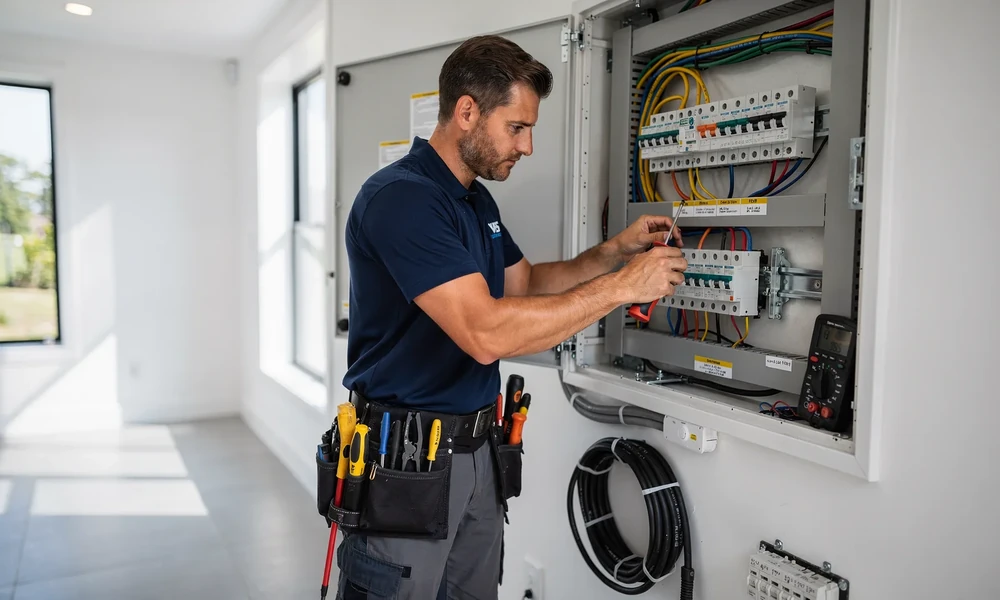
Minnesota takes a firmer line on household wiring than many states. Its electrical licensing law reaches almost every wire, box and breaker in a home, and it leaves homeowners only one narrow door to walk through on their own.
That door is real, though. A person who owns a single family house and lives in it can pull a permit and do much of the work personally, as long as an inspector signs off at the end. The tricky part is knowing which projects fit through that opening comfortably and which ones only look like they do.
A licensed Eden Prairie electrician such as Gray Duck Electric will often hear the question in the middle of a basement finish or a garage project, when a homeowner has already done the framing and wonders whether the wiring could be next. The honest answer depends on the job, the property and who would actually be holding the tools.
The Fine Print Behind the Homeowner Exemption
The state’s definition of an owner is surprisingly specific. Under Minnesota Statutes section 326B.31, the exemption covers someone who physically performs electrical work on premises they own and occupy as a residence, or will occupy once construction is finished. Inspection authorities around the state read that wording closely, and the permit applications reflect it.
In practice, the exemption comes with a handful of conditions.
- The owner has to live in the home, so rental houses and units occupied by tenants are excluded.
- The owner must do the work personally, which rules out a handy brother in law or an unlicensed friend who “does this for a living.”
- A permit has to be filed before work begins, and the job needs a final inspection.
- Smaller permits with inspection fees of $250 or less expire 12 months after they are issued, so a project that stalls over winter may need a new permit.
- Some local inspection authorities add their own limits, particularly around service equipment.
With those rules in mind, the nine jobs below fall into three fairly clear groups.
Well Within an Owner’s Reach
1. Replacing a light fixture or a worn receptacle.
It feels like a ten minute chore, yet reinstalling a luminaire or device still counts as electrical work under state rules. An owner living in the home can legally handle it. The common mistakes are small but meaningful. People reuse a backstabbed connection, overfill a shallow box from the 1980s, or skip the GFCI protection that kitchens, bathrooms, garages and basements now require.
2. Adding outlets or a circuit while finishing a basement.
Walkout and lookout basements are a staple of Twin Cities suburbs, and finishing one is the most common reason homeowners pull their own electrical permit. The key moment comes before the drywall goes up. An inspector needs to see the rough in wiring while it is still exposed, and that inspection catches box fill, missing cable staples and circuits that lack arc fault protection.
3. Swapping a switch for a smart switch.
This sits comfortably in owner territory, with one catch that sends many people back to the hardware store. Most smart switches need a neutral wire in the box, and houses from several decades ago often ran switch loops without one.
Legal on Paper but Demanding in Practice
4. Running a dedicated circuit for an EV charger.
An owner can legally install a 240 volt circuit for a Level 2 charger. The difficult part is the arithmetic. A 48 amp charger needs a 60 amp breaker, and plenty of 100 amp and older 150 amp panels simply lack the capacity once furnaces, dryers and ranges are counted. A load calculation should come before any cable gets pulled.
5. Wiring a hot tub.
Spas combine water, high amperage and outdoor exposure, and the code responds with specific requirements for GFCI protection, disconnect placement within sight of the tub, and burial depth for underground feeders. Owners do sometimes complete this work successfully, though inspectors tend to look at it with extra care.
6. Connecting a portable generator with an interlock or transfer switch.
Minnesota winter storms make this a popular project. A proper interlock kit or transfer switch prevents backfeeding, which can energize utility lines and endanger line workers. Owners may install one under permit, but mislabeled circuits and the wrong breaker type are common problems.
Work That Belongs to a License
7. Upgrading the electrical service or main panel.
Service work involves the utility meter, the service entrance conductors and coordination with the power company to disconnect and reconnect. Some inspection authorities limit or prohibit owners from touching service equipment at all. Even where it is technically allowed, a mistake at this stage has no fuse in front of it to stop the damage.
8. Anything inside a rental property or duplex unit you don’t live in.
This is where the exemption ends completely. If tenants occupy the space, or the owner lives elsewhere, the law requires a licensed electrical contractor. That holds true for a single outlet just as much as for a full rewire.
9. Wiring in a commercial space.
A shop, an office suite or a home based business in a separate commercial building falls outside the residential exemption. Licensed contractors in Minnesota must also have a responsible master electrician on record, and that structure is the state’s way of making sure someone carries accountability for every job.
Why the Permit Outlasts the Project
The paperwork tends to resurface years later, often at an awkward moment. Buyers’ inspectors notice newer wiring in an older basement, insurance adjusters ask about permits after a fire or water claim, and appraisers may hesitate to credit finished space that has no record behind it. A closed permit with a passed final inspection answers those questions in a single document, whether the owner or a contractor did the work.
Minnesota also updates its electrical code on a regular cycle, and each new edition expands requirements such as arc fault and ground fault protection. A circuit wired to an outdated standard can fail inspection even when it works perfectly. The homeowner exemption gives people real freedom over their own houses. It works best when the person using it knows exactly where its edges are and treats the inspector as a second set of eyes rather than an obstacle.
