

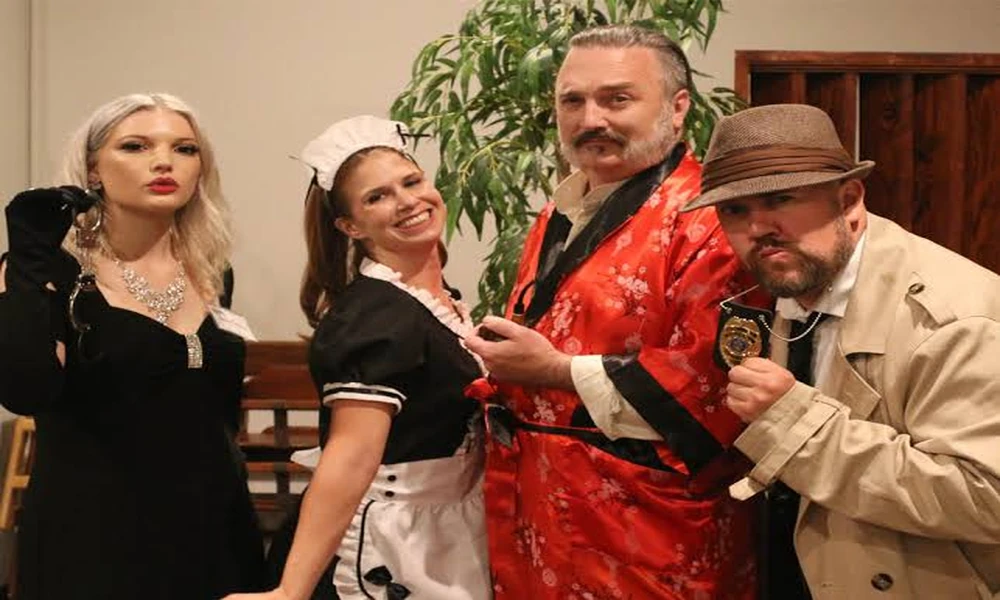
Most murder mystery parties die in the second hour. The clues dry up, two guests are still pretending to be suspects while everyone else checks their phones, and the host is stuck in the kitchen reheating something. I’ve hosted enough of these to know the fix isn’t a bigger budget or a fancier script. It’s pacing, casting, and one genuinely good twist.
Here’s what you’re getting: a repeatable way to run the night so the room stays loud and nobody drifts off. If you’d rather skip the hosting and just play detective while a train rolls through the dark, a Mystery Train Fort Myers, FL experience hands you a five-course dinner, a live scripted show, a playbill, and a clue sheet, with actors playing the suspects in the aisles. That’s the bar you’re trying to clear at home.
Below are the decisions that matter, in the order you’ll face them. I’ll tell you which way I’d go on each and why.
Pick your format before you pick a single character
Murder mystery nights come in three flavors, and they are not interchangeable.
- Scripted box game. Everyone gets a role, a backstory, and a packet of facts to reveal in order. Low effort for you, low energy from the guests.
- Open investigation. Guests are themselves, not characters. They interrogate actors or hosts and hunt physical evidence around the house. Higher prep, far better buzz.
- Hybrid. A short scripted cast plays the core drama, and everyone else is a detective with real tasks.
I’d pick the hybrid every time. Your friends who love performing get a role. Your friends who hate performing get a clipboard and a job. Nobody spends the night in costume wishing they’d stayed home, and nobody is forced to memorize paragraphs they’ll read off a card anyway.
The Three Round Rule that keeps the night moving
This is my own framework, and it exists because I watched too many hosts treat clues like confetti. Throw everything at the wall and the room drowns.
Structure the night in three rounds only. Each round has one reveal, one physical clue, and one private conversation the players have to earn.
Round one drops the body and the timeline. The guests learn who was where, but not why. Round two breaks an alibi, quietly, through something they can hold: a torn ticket, a lipstick-stained glass, a note that doesn’t match the handwriting on the menu. Round three fires the accusation. Any evidence you don’t use in one of those three rounds gets cut. It’s not precious. Cut it.
Three rounds fits an evening. The first one settles nerves and gets the louder guests talking. The second is where the real theorizing happens, once people believe there’s a puzzle to solve. The last round is loud, fast, and short on purpose.
Cast the troublemakers, not the theater kids
Everyone assumes you hand the juicy roles to the person with the biggest personality. Wrong instinct. Give your suspects to the people who will withhold information until someone drags it out of them.
Your job as host is to build friction, not performance. A guest who gives up their secret in the first twenty minutes is a dead end. A guest who makes the table work for it is the engine of the whole night.
Keep the cast small, too. Four or five suspects is plenty for a dinner party of twelve. Two of them should have an obvious grudge against the victim, and one should seem completely uninvolved. That last one is almost always your culprit, and it only works if you resist the urge to wink at the table while you cast it.
Food, drink, and the room itself
Serve food that doesn’t require a fork to negotiate. Small plates, one hand, no carving at the table while the plot moves. The moment your guests sit down with a knife and a bone-in chop, the mystery pauses and the meal takes over.
Lighting does more work than any prop. You want pools of warm light over the tables and dim edges, so the corners of the room feel like somewhere a secret could be kept. Odd, older venues do this naturally, and that’s part of why the railroad car format works. There’s a reason so many of these experiences live in heritage settings. The National Park Service maintains thousands of historic structures across the country, and a century-old station or depot gives a mystery night atmosphere that no string lights from a party store can fake.
One practical note on timing: put the second reveal right after dessert is cleared, not before. People get louder and braver with sugar in them, and the questions get sharper. I’ve watched a table of polite strangers turn into an actual interrogation unit over a plate of brownies.
A table setup scenario you can steal
Here’s the exact arrangement that worked best for me.
Twelve guests, round tables of four, four suspect roles. Every table gets a sealed envelope at the start with three clue cards inside, and only one card is true. That last detail is the good part. Each table has to argue about which card to believe, then send one representative to the host with their conclusion. You’re not just running a mystery. You’re running four small arguments that all feed the same final accusation.
It also fixes the shy-guest problem. In a group of four, everyone talks. In a group of twelve, three people talk and the rest watch.
For the reveal, hand out blank cards and ask every guest to write the killer’s name and one sentence of reasoning. Collect them before you read the answer aloud. The reasoning is where the entertainment lives. Somebody will have constructed a theory so elaborate and so wrong that it becomes the story people tell about the party for years. Keep the winning card. I still have one framed.
What to actually spend money on
Skip the elaborate props. Skip the custom tablecloths. Spend on three things: good food, a host or actor who can improvise when the plot stalls, and a venue that feels slightly wrong in a good way.
The improv piece is non-negotiable. Every mystery night has a flat moment around the middle. A trained host reads the room and drops a new complication. A scripted packet can’t do that.
If you’re curious how far this genre has traveled, it’s worth knowing that public fascination with detective fiction is over a century old. The Library of Congress holds one of the largest collections of mystery and detective fiction in the world, and the format’s longevity tells you something useful. People return to this structure because the puzzle gives them a reason to talk to each other, which is the real product underneath all the fake blood.
Clues don’t solve the night, people do
You can buy a script tonight and run it next weekend. What you can’t buy is the version where four tables are arguing over a card, the suspect nobody suspected is sweating through the dessert course, and three people ask when the next one is before they’ve found their coats.
Build it around three rounds, cast your best secret keepers, feed everyone something they can eat standing up, and let the room do the work. Then pick the killer you’d never suspect yourself. Your guests will spend the entire drive home explaining why they almost had it.
